
Have you ever found yourself asking, ‘Why can’t I accomplish things that are important to my success?’ If so, you’re not alone. This question has been a recurring theme in my personal journey, and I suspect it’s one that resonates with many of you.
I asked my friends, business owners, and participants in my training sessions this question, and their answer was a strong “Yes.” It’s frustrating even to me if I have things to do and know their importance, yet I can’t finish or do the task. Only when I had to do something about it on the last day did I anxiously and stressfully try to do it? The problem with that, since I am rushing against the deadline, is a sloppy outcome or a failure to complete the task with devastating results.
No matter how well I planned, the outcome was different. I realized that planning and execution are entirely separate skill sets. Why do we suffer from failure in execution when we can be good at planning and goal setting? What keeps us from achieving our goals?
In my journey as an entrepreneur, I have many stories about my failures in achieving and executing my goals.
Every year, before the end of the year, I start setting goals for the coming year. One of my top goals in 2023 was to launch a community or a Chapter composed of entrepreneurs in different fields in 13 weeks. The process was designed to bring results. It is a proven method and has been effective worldwide.
I followed the process but failed to accomplish it on time. It was very frustrating and cost me a lot of time. From 13 weeks, it extends to almost 50 weeks. Going back to my experience and studying how I execute the process, I discovered that no matter how well I plan, the outcome will always depend on how I execute it. I must learn to clear the path that stops me from achieving my goal.
From that experience, I knew I had to find a tool to help me become a better entrepreneur and leader. That’s when I discovered the 4DX of Execution, authored by Chris McChesney, Jim Huling, and Sean Covey. It is a framework for executing strategies designed to achieve a few critical goals. It comprises four key disciplines: Focus on the Wildly Important Goals (WIGs), Act on the Lead Measures, and Establish a cadence of Accountability.
Here are the 4 Disciplines of Execution in a nutshell.
- Focus on the Wildly Important Goals (WIGs): Identify and prioritize a few critical objectives that will make the most significant impact on achieving your organization’s mission. These are the Wildly Important Goals (WIGs).
- Act on Lead Measures: Identify the specific actions or behaviors (lead measures) that will drive progress toward achieving the WIGs. Focus on proactive indicators that predict future success rather than lag measures that reflect outcomes after the fact.
- Create a Compelling Scoreboard: Develop a visual representation of progress toward the WIGs that is simple, relevant, and prominently displayed. The scoreboard should motivate and engage team members by providing real-time feedback on performance.
- Establish a Cadence of Accountability: Hold regular meetings, check-ins, and reviews to track progress, identify obstacles, and hold team members accountable for their commitments. Foster a culture of transparency, collaboration, and shared responsibility to ensure Accountability throughout the organization.
By implementing these disciplines, organizations can focus their efforts, drive performance, and achieve their most important goals effectively.
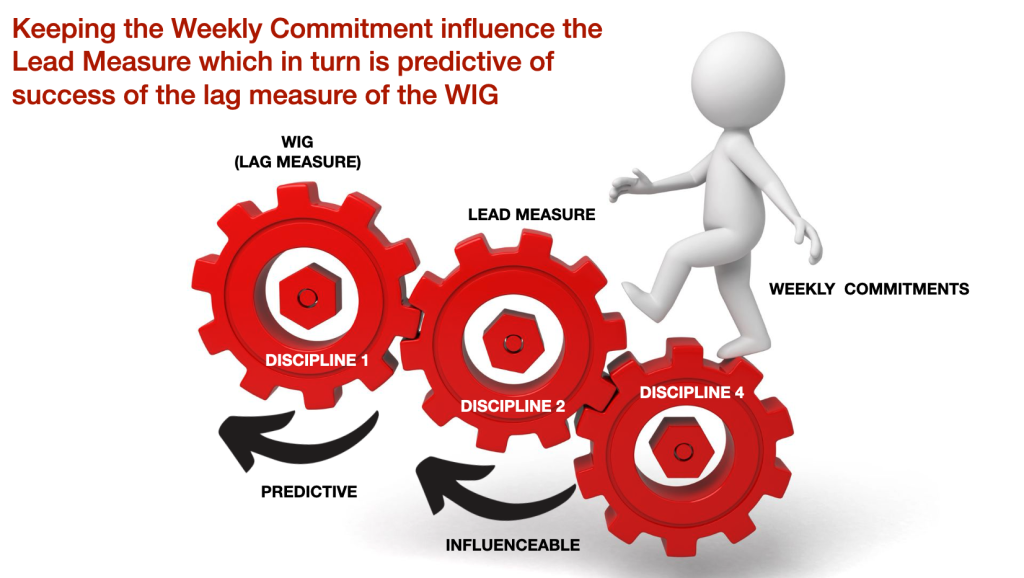
After learning all of these, I became a better leader and implementor of change. There are two ways to accomplish a goal. One is by creating a policy or using your authority—Covey called it the “stroke of the pen” initiative. But the difficult one to make changes is the one that requires a change in behaviour. That is where the 4DX can be applied.